
As regulatory scrutiny increases and digital-first submission models mature, expectations have shifted. The real question is no longer: “Is the IFU available electronically?”
It is: “Can the organisation demonstrate control, traceability, and defensible change across the product lifecycle?”
What Does the “E” in eIFU Really Stand For?
Electronic Instructions for Use, or eIFUs, are now an accepted part of how medical devices are brought to market and supported. For most organizations, the move away from printed IFUs was driven by a combination of regulation, cost, and practicality. Electronic delivery solved real problems, particularly for global distribution, and it quickly became the default.
Because of that, it is easy to think of eIFU as a completed task. The instructions are no longer printed, they are available online, and the obligation feels closed. In many conversations, “electronic” quietly becomes synonymous with “done”.
That assumption tends to hold until expectations start to change. As accountability increases and scrutiny tightens, the focus shifts away from whether information exists and toward how it moves, how it changes, and whether organizations can truly stand behind it. At that point, it becomes reasonable to pause and ask what the “E” in eIFU was ever really meant to represent.
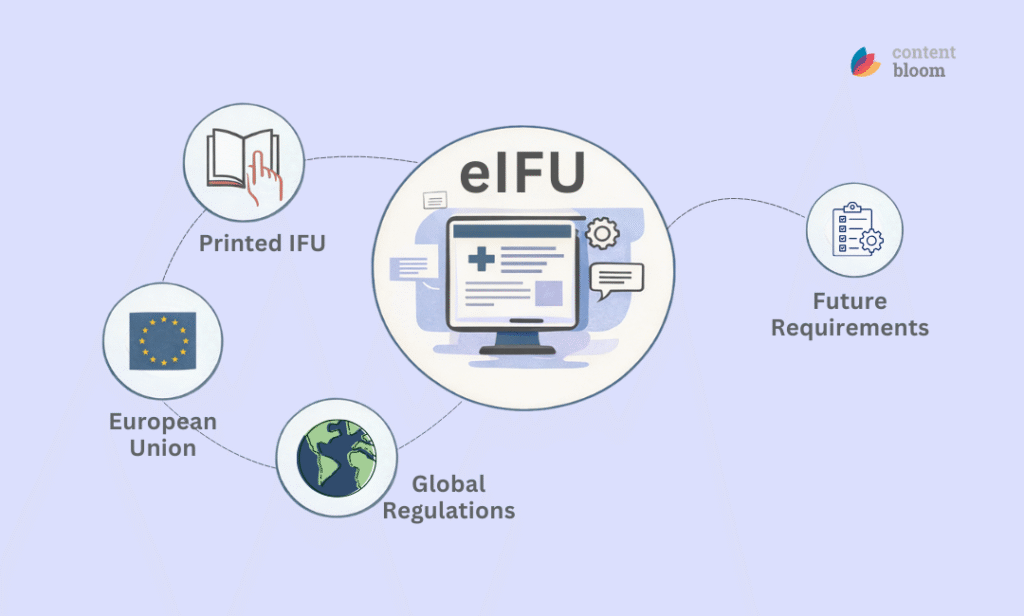
When “Electronic” Becomes the Minimum
Most eIFU initiatives begin in a sensible place. Standardization improves, version control becomes more reliable, translation effort reduces, and audit preparation becomes less painful. Internally, these improvements are tangible and often hard-won.
Externally, however, very little appears different. From the user’s perspective, the experience often remains a PDF, now accessed through a website rather than a box. The delivery channel has changed, but the interaction has not.
This is usually where progress slows, not because teams have failed, but because “electronic” on its own does not address how information is actually used or how change is managed once products are in the field.
eIFUs as Regulatory Dependencies
In reality, IFUs are rarely standalone documents. The same content feeds into technical files, risk management activities, clinical evaluations, post-market surveillance outputs, and regulatory submissions. It is reused across product variants and over long lifecycles.
As a result, IFUs quietly become a dependency that many other regulated activities rely on, often without being treated as such. As that web of dependency grows, so does the pressure on consistency, traceability, and evidence.
When IFUs are treated as flat documents, managing those relationships becomes increasingly brittle. When they are treated as governed information, the same complexity becomes far easier to control.
Why Structures Change Everything
This shift becomes more visible as regulators grow more comfortable with electronic and digital-first submission models. That change does not reduce expectations. It increases them.
If information is expected to move cleanly through electronic processes downstream, then the way it is created and managed upstream starts to matter much more.
Authoring IFU content as structured information rather than as a single monolithic file changes the nature of the work. Approved content can be reused without reopening risk. Changes can be applied precisely instead of being spread across entire documents. Preparation moves away from reinvention and toward controlled assembly.
Over time, quality improves not through effort, but through predictability.
What has changed is not the intent behind centralization, but the shape of the organization it is now serving. Markets have matured at different speeds. Some face constant digital competition and compressed decision cycles. Others continue to perform steadily without dramatic change. Some have transformed quietly, developing the capability and confidence that were not anticipated when the operating model was designed. Yet many are still expected to function within governance structures built on the assumption of uniform maturity.

The Gap Between Publication and Proof
The real pressure tends to appear around change. Most organizations are very clear on when an IFU needs to be updated. They know how to approve it, and they know how to publish it.
What is often less clear is what happens after publication.
Did the people using the device notice the change?
Did they understand what was different, or did it blend into a full document revision?
Can the organization reasonably demonstrate that the update was received by the people it mattered to?
Making an updated PDF available only answers part of that question. Availability is not the same as awareness, and awareness is not the same as acknowledgement.
For teams carrying regulatory and quality responsibility, that gap matters because it is where uncertainty lives.
Change, Responsibility, and Defensibility
When products evolve quickly, that uncertainty becomes harder to tolerate. Post-market surveillance, vigilance, and real-world usage all drive updates that need to be communicated clearly and defensibly.
Organizations need to know what changed, who it was relevant to, and whether reasonable steps were taken to ensure it was received.
Without that feedback loop, teams compensate manually. Emails are sent, phone calls are made, and coordination efforts increase, not because it is efficient, but because reassurance is needed. Over time, this becomes a quiet operational burden.
At that point, “electronic” stops describing the channel. It describes a capability. One that makes the content work harder, delivering consistency, resilience, and compounded return.“
From Assumption to Evidence
When eIFUs are managed as structured information rather than static files, that loop can be closed more cleanly.
Changes are visible rather than buried. Notifications can be targeted rather than generic. Acknowledgement can be captured rather than assumed.
This is not about monitoring behaviour or guaranteeing outcomes. It is about replacing assumptions with evidence.
Importantly, this does not weaken regulatory control. It strengthens it. The experience layer exists to support governance, traceability, and auditability, not to compete with them.
What the organization gains is not just efficiency, but confidence that change has been handled responsibly.
Is your content model built for predictable change?
If your eIFU strategy stops at publication, it may already be behind regulatory expectations.
What the “E” Ultimately Represents
Which brings the question back into focus.
Electronic delivery is now the baseline. Publishing an eIFU to a website is expected. The real difference lies in whether the organization can demonstrate clarity, control, and accountability once change begins.
When eIFUs are treated as governed information rather than static files, they stop being something that is merely published. They become part of a predictable system that organizations can stand behind.
At that point, the “E” in eIFU starts to represent something far more important than the fact that the information happens to be delivered electronically.
Addendum: Operational Implications of Structured eIFU Governance
When eIFU content is created and managed as structured, governed information, the practical implications extend beyond publication. They typically include:
• Controlled reuse of previously approved content
• Reduced revalidation effort across product variants
• Clear lineage between IFU content and related technical documentation
• Faster, lower-risk updates during post-market changes
• Consistent outputs across submission packages
• Improved traceability during audits
• Reduced translation overhead through modular reuse
• Greater predictability in long product lifecycles
These are not theoretical improvements. They are operational consequences of treating content as a managed asset rather than a static file. The future of regulated industries isn’t electronic documents. It’s predictable knowledge operations.
FAQs
1. What is the difference between a static eIFU and a structured digital IFU?
While a static eIFU is typically a digitized PDF hosted online, a structured digital IFU treats content as a governed, modular asset.
• Static eIFUs satisfy the basic regulatory requirement for electronic delivery but lack traceability and ease of update.
• Structured IFUs allow for controlled content reuse, precise versioning at the component level, and automated updates across technical files. This shift transforms “electronic” from a delivery channel into an organizational capability that enhances auditability and reduces translation overhead.
2. How does structured eIFU governance improve post-market surveillance and defensibility?
Structured eIFU governance closes the “publication-to-proof” gap by replacing assumptions with evidence. Unlike static PDFs, a structured system allows organizations to:
• Target Notifications: Alert specific users to relevant changes rather than sending generic document updates.
• Capture Acknowledgement: Provide documented proof that critical safety updates were received and acknowledged.
• Ensure Consistency: Maintain a clear lineage between the IFU, risk management activities, and clinical evaluations, ensuring that a change in one is accurately reflected across all regulated dependencies.
3. What are the operational benefits of moving to a managed asset model for eIFUs?
Transitioning from static files to managed content assets creates a “compounded return” on efficiency. Key benefits include:
• Reduced Revalidation: Only the changed module requires re-approval, rather than the entire document.
• Translation Savings: Modular reuse ensures you only translate new or updated content, significantly lowering localization costs.
• Audit Readiness: Automated traceability provides a clear history of what changed, who approved it, and when it was published, simplifying regulatory submissions and technical file maintenance.