
The “So What?”: Why manage risk? Because preventing an issue is significantly cheaper than fixing one. Unchecked risks don’t just delay timelines; they block cash flow and derail sales goals.
The Core Shift: Risk-Based Thinking (RBT) is a decision discipline, not a documentation chore. It’s about proactive evaluation of uncertainties to protect business momentum.
The AI Advantage: AI tools (like Confluence Rovo or Copilot) aren’t magic, their effectiveness depends entirely on the structure of your delivery data. Well-structured signals amplify insight; messy data only amplifies noise.
The Reality Check: “So What if We Don’t Do It?”
At a recent Technical Practice Workshop, a critical question was raised by Nick (CEO at Content Bloom): “What’s the difference if you don’t manage these risks?”
The answer is simple but brutal: Delivery risk is business risk.
In major digital transformation programs, failure builds quietly, sprint by sprint. When we ignore these signals, we aren’t just missing a deadline, we are actively damaging the organization’s bottom line. Delayed launches mean delayed revenue. Content supply-chain bottlenecks mean missed market opportunities. In short, a failure to manage risk is a choice to let costs balloon and cash flow stagnate.
Preventing an issue is always more cost-effective than a post-mortem.
What is Risk-Based Thinking?
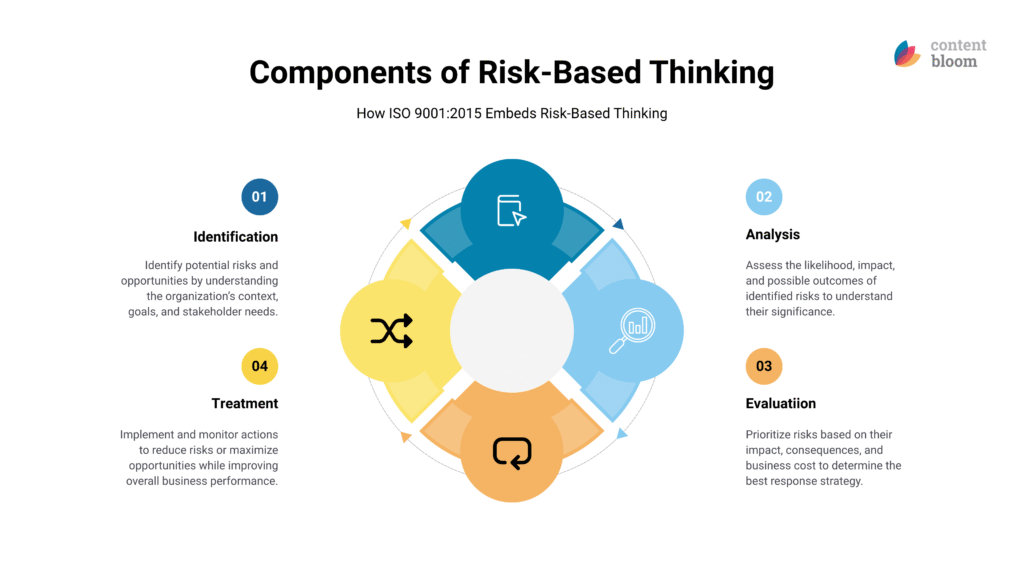
To move beyond simple “firefighting,” we must look at the formal framework of Risk-Based Thinking (RBT).
Rather than just looking for what might go wrong, it is a proactive approach that requires organizations to evaluate risk while establishing the very processes, controls, and improvements that make up a Quality Management System (QMS).
In the context of digital delivery, Risk-Based Thinking (RBT) means we don’t just react to problems, but we use our collective knowledge to anticipate uncertainties and turn them into opportunities for optimization.
Risk Management is a Behaviour, not a Document.
Too often, risk management is reduced to maintaining a “Risk Register,” which is a static artifact created to satisfy a governance checkbox but rarely used to steer the ship.
A risk log that doesn’t influence daily action is just expensive paperwork.
Risk-Based Thinking (RBT) reframes the conversation. It’s about how teams make choices when information is incomplete, which is the permanent state of modern digital delivery. While high-performing teams often do this instinctively, the challenge is scale. Without a systematic approach rooted in Risk-Based Thinking (RBT), consistency suffers, and delivery momentum becomes dependent on individual “heroics” rather than a reliable, repeatable system.
The Executive Reality: Protecting Cash Flow and Sales Goals
For enterprise leaders, delivery risk isn’t a “back-office” technical concern. In complex digital ecosystems, a missed dependency doesn’t just delay a technical sprint. It:
- Stalls Global Campaigns: Directly impacting sales targets.
- Disrupt Personalization: Failing to convert customers when it matters most.
- Exposes Compliance Gaps: Leading legal and financial friction.
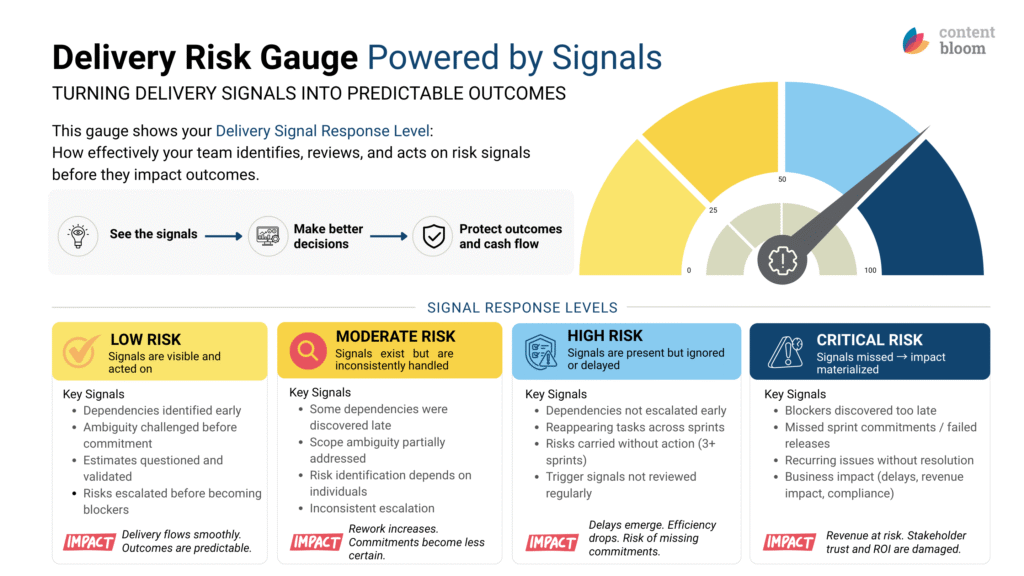
Bridging the Gap: From Signal to Decision, identifying that your Delivery Risk Gauge is reflecting High Risk Scores or reaching Critical Thresholds is the first step toward operational control. As the gauge illustrates, high-risk environments are defined by signals that are inconsistently handled or ignored, eventually damaging stakeholder trust and ROI.
The real executive challenge is: Once a score exceeds your risk appetite, do you have the structural visibility to intervene before the impact materializes? Most organizations fail here, not because they lack data, but because they struggle to synthesize complex metrics into a clear “So What?” In the following section, we will explore how we can move from manually tracking these scores to a model of Predictive Delivery, leveraging a layer of intelligence that buys leadership the most valuable commodity in digital transformation: time.
Is your delivery risk blocking your cash flow?
Turn your delivery signals into predictable ROI with Risk-Based Thinking.
The AI Layer: Structure Precedes Intelligence
We often hear about the power of AI tools like Confluence Rovo, Microsoft Copilot, or specialized ML agents to scan delivery data for hidden patterns. However, there is a subtle truth we must acknowledge:
AI effectiveness is a function of data structure.
If your risk signals and sprint data are well-structured, AI acts as a force multiplier, surfacing “reappearing tasks” and hidden friction points before they become crises. Without that underlying structure, even the most advanced AI will struggle to derive actionable patterns.
Showcase: Turning Project Artifacts into Predictive Power
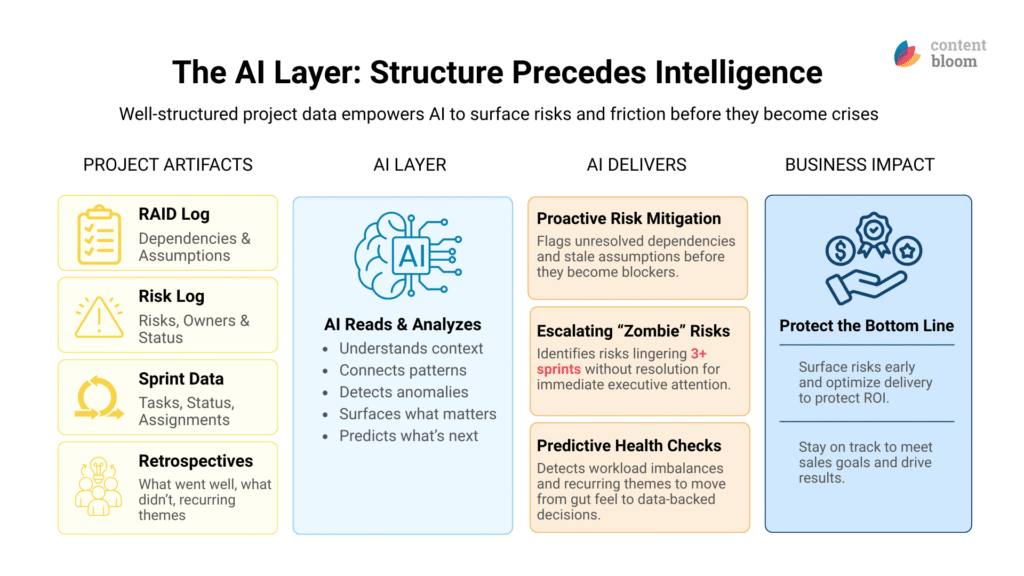
When we align AI with a structured Risk-Based Thinking approach, we gain a level of visibility that was previously impossible:
- Proactive Risk Mitigation: By reading RAID and Risk Logs, AI can flag unresolved dependencies and “stale” assumptions before they evolve into critical blockers.
- Escalating “Zombie” Risks: AI identifies risks that have lingered for 3+ sprints without resolution, surfacing them for immediate executive attention rather than letting them quietly stall progress.
- Predictive Health Checks: By analyzing Sprint Data and Retrospectives, AI detects workload imbalances and recurring themes that humans might overlook. This moves the conversation from gut feeling to evidence-based decision-making. For instance, identifying a trend of increasing technical debt before it impacts your cash flow.
Ultimately, using AI to surface these trends is about protecting the bottom line. Whether you use Confluence Rovo, Copilot, or Wrike, the goal is the same: converting delivery signals into structured indicators that protect your ROI and keep you on track to meet your sales goals.
From Periodic Review to Continuous Delivery Management
Predictable delivery requires a rhythm, not just a report. At Content Bloom, we’ve found the most impact comes from a lightweight but disciplined weekly “Trigger Check.” By focusing on key indicators rather than exhaustive spreadsheets, teams can validate assumptions and adjust course in real-time.
The ambition is clear: Leading organizations no longer wait for risks to materialize. By combining the discipline of Risk-Based Thinking (RBT) with AI-enabled visibility, enterprises can:
- Accelerate Content Velocity without sacrificing quality.
- Reduce Firefighting Costs by addressing triggers, not just crises.
- Protect ROI by ensuring launch timelines stay aligned with sales goals.
Ultimately, the purpose of Risk-Based Thinking (RBT) is to improve the quality of the decisions that shape your program’s momentum. When delivery signals are visible and actionable, organizations gain something far more valuable than risk reduction: They gain control.
In a landscape defined by constant change, that control is what enables an enterprise to move faster, protect its cash flow, and innovate with confidence.
FAQs
Q1: How does Risk-Based Thinking (RBT) differ from a traditional Risk Register?
A: A Risk Register is often a static compliance artifact. Risk-Based Thinking (RBT) is a dynamic, proactive approach. According to ISO 9001:2015, it’s the application of knowledge to determine uncertainties. It moves risk management from a “checkbox” activity to a real-time decision-making tool.
Q2: What is the role of AI in managing IT delivery risks?
A: AI acts as a visibility layer. Tools like Confluence Rovo or Copilot analyze platform data to spot patterns humans miss, such as tasks that consistently “hop” between sprints. However, for these tools to work, your underlying delivery data must be well-structured.
Q3: Why should enterprises care about “Predictive Delivery”?
A: Because reactive management is expensive. Predictive Delivery uses early-warning signals to address risks before they impact cash flow or sales goals. It’s the difference between controlled navigation and constant firefighting.