How a North American Enterprise Reduced Digital Asset Distribution Time by 95%

Home > Work > How a North American Enterprise Reduced Digital Asset Distribution Time by 95%

Business Context

Enterprise Marketing Moves at the Speed of Its Content Value Stream

A North America–based global enterprise manages multiple brands across three regions, producing and approving hundreds of digital marketing assets every month via Adobe Workfront. Once approved in Adobe Workfront, finalized digital assets were transferred to Adobe Experience Manager – DAM(AEM DAM) for centralized storage, metadata management, governance, and long-term reuse. From AEM DAM, these assets could then be distributed to partners through Adobe Brand Portal or reused across enterprise websites and web pages.

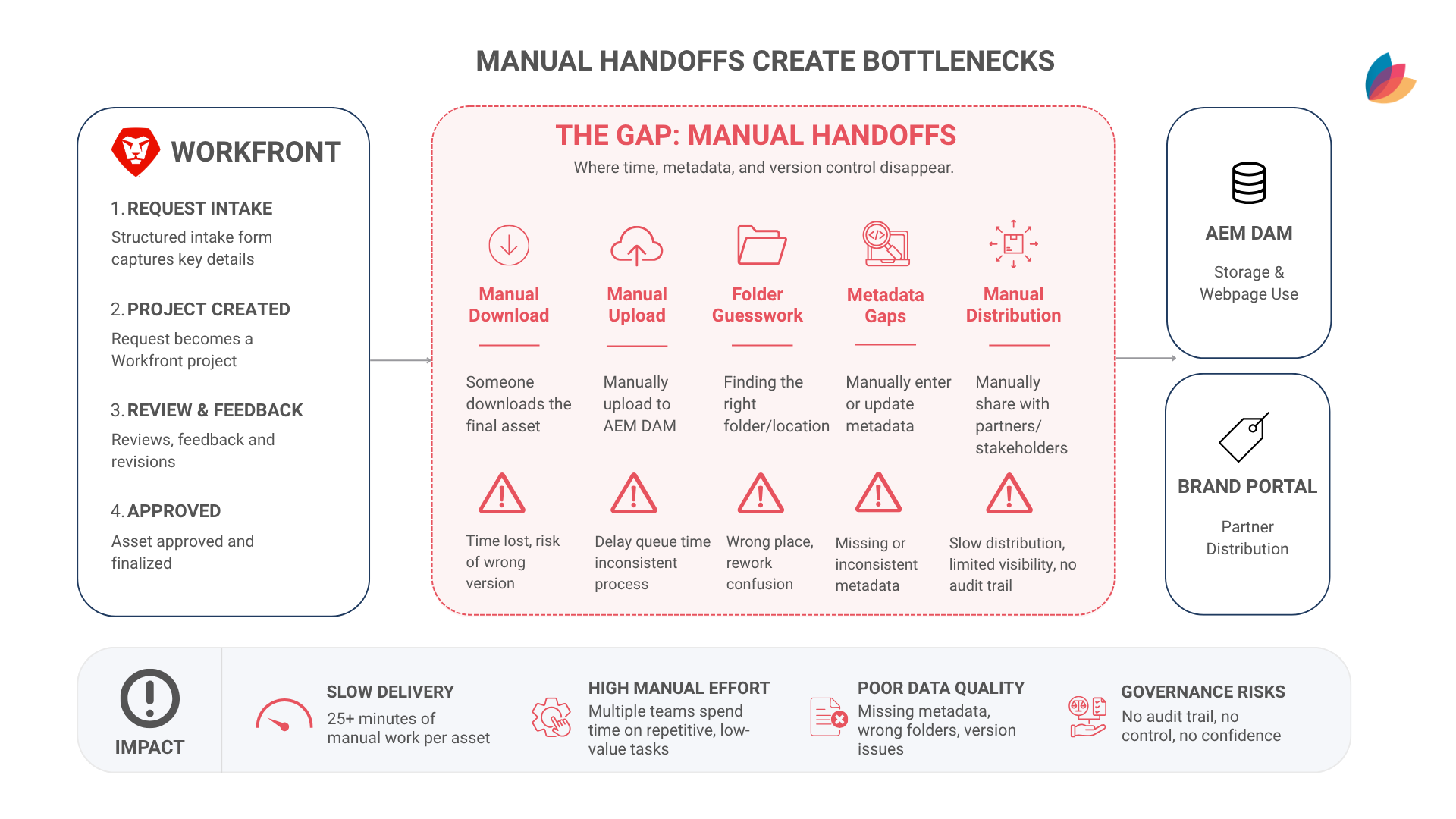
As enterprise campaigns grew, the process became increasingly dependent on manual coordination across marketing teams. Each asset moved through multiple platforms, but the stages of creation, approval, storage, reuse, and distribution remained disconnected. Rather than operating as a unified Content Value Stream, these activities functioned as separate handoffs, creating inefficiencies and increasing the effort required to manage assets at scale.

While each platform supported a different stage of the content lifecycle, there was no standardized operating model governing how assets, metadata, and version information moved between them. The gaps between platforms created operational bottlenecks that slowed the Content Value Stream and made it increasingly difficult for marketing operations to scale.

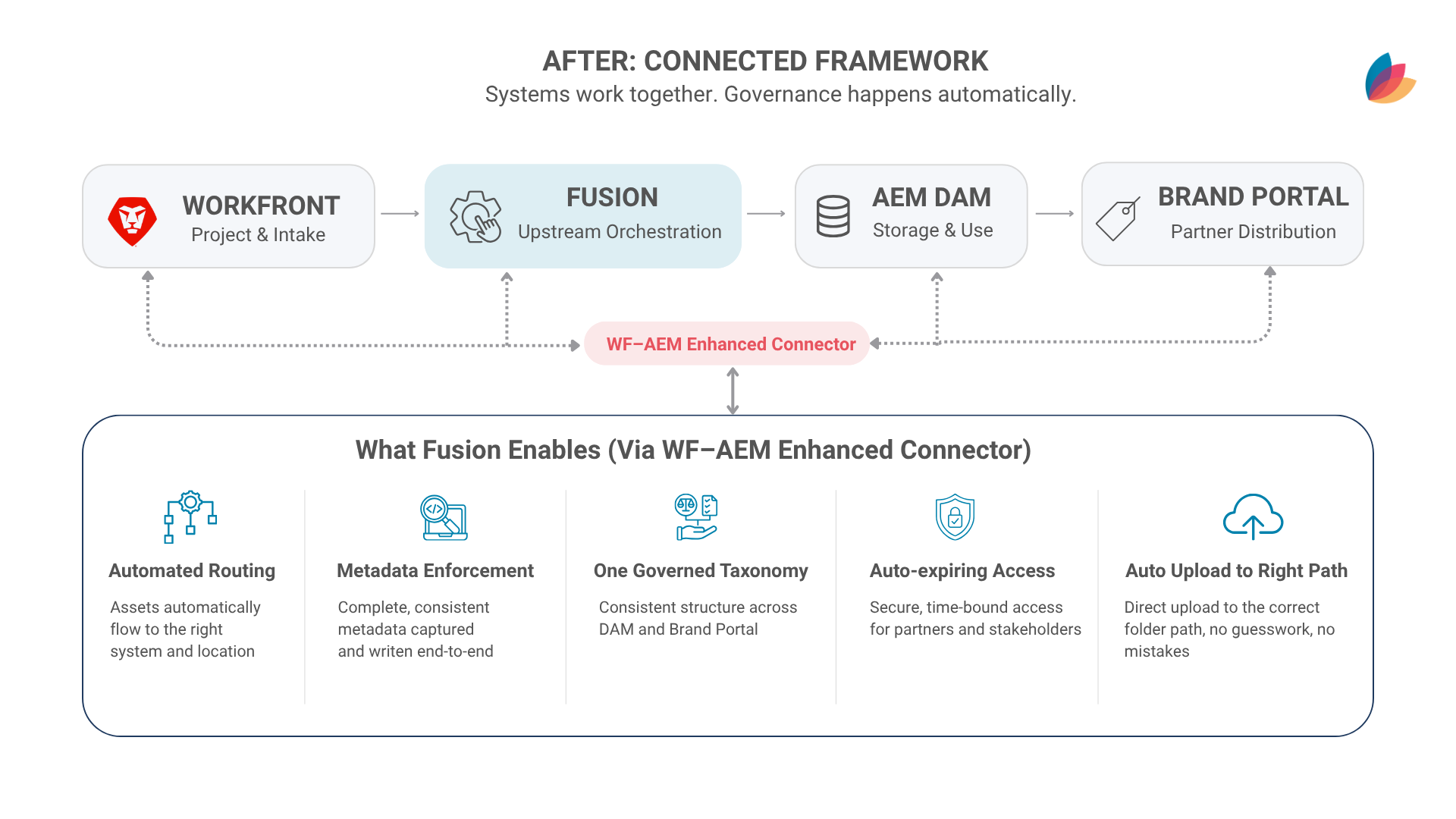
Content Bloom transformed the asset lifecycle by introducing a governed automation framework built on the Adobe Workfront–AEM DAM Enhanced Connector and Workfront Fusion. The framework connected previously fragmented handoffs into an end-to-end Content Value Stream, automating the movement of approved digital assets from Workfront into AEM DAM and downstream distribution. By removing these operational bottlenecks, the solution reduced publishing and distribution time by approximately 95% and now supports up to 200 assets per month, with eight brand teams live across three regions and two additional brand teams in the pipeline.

Challenge

Disconnected Handoffs Became an Operational Bottleneck

Every approved asset depended on manual coordination before it could be stored, reused, or distributed. What appeared to be a straightforward marketing workflow had become an operational constraint that grew with every campaign. Marketing teams spent valuable time coordinating handoffs instead of launching campaigns, while regional teams waited longer for approved content to become available.

The operating model relied on people rather than process: 

  • 8 brands across 3 regions
  • Hundreds of assets processed every month
  • 40+ minutes of manual effort per approved asset
  • Governance, metadata, and version control depended on manual execution

Each Adobe platform performed its intended role effectively, but the handoffs between them remained disconnected. Without an integration layer connecting the platforms, content could not move seamlessly through a unified Content Value Stream.

Solution

Creating a Governed Content Value Stream

Content Bloom designed and implemented a connected operating model that connected Adobe Workfront, AEM DAM, and Adobe Brand Portal into a single governed Content Value Stream. Approved assets now move automatically from creation through storage, publishing, reuse, and distribution across the extended enterprise, while governance, metadata, and version control remain connected throughout the lifecycle. The result is a scalable enterprise capability that reduces manual effort and enables marketing teams to move faster as the business grows. The operating model focused on five enterprise capabilities:

Capability 01

Build One Connected Content Value Stream

Content Bloom integrated Adobe Workfront, AEM DAM, and Adobe Brand Portal into a single governed workflow that carries every approved asset from creation through storage, reuse, publishing, and distribution across the extended enterprise.


Instead of relying on individuals to manually move files between systems, asset movement now follows predefined business rules. Every approved asset automatically progresses through the next stage of its lifecycle, eliminating manual downloads, uploads, and unnecessary coordination between teams.


The result is a connected operating model where every approved digital asset follows the same governed path from creation to distribution, providing a repeatable foundation that scales across brands, regions, and the extended enterprise.

Capability 02

Establish Enterprise Asset Governance

Successful automation depends on consistent governance. Before introducing automation, we redesigned the AEM DAM architecture and folder structure around brands, regions, campaigns, projects, and asset types, establishing a standardized framework for how enterprise assets are organized.


Metadata standards, naming conventions, and folder structures were defined together, ensuring every approved asset reaches the correct destination with the appropriate business context already attached. Governance became the foundation that allowed automation to scale reliably.

Capability 03

Asset Movement with Business Rules

Once an asset is approved in Adobe Workfront, the framework automatically routes it into the correct AEM DAM location while preserving all associated project information, including brand, region, campaign, asset type, and project metadata.


Workfront Fusion orchestrates every routing decision based on predefined business rules rather than manual intervention, eliminating repetitive administrative work while maintaining complete traceability throughout the asset lifecycle. Every asset entering AEM DAM is immediately searchable, correctly classified, and fully connected to the Workfront project that created it.

Capability 04

Maintain One Approved Version Across Every Channel

A trusted workflow established a coherent single source of truth for every approved and trusted digital asset.


Approved and trusted assets remain synchronized across Adobe Workfront, AEM DAM, Adobe Brand Portal, and published digital experiences, ensuring internal teams, regional marketers, the extended enterprise, and customers all access the same approved version.


Consistent metadata, automated version management, and governed publishing maintain that coherence across the Content Value Stream, eliminating uncertainty around which asset is current while improving searchability, discoverability, and confidence in content reuse across brands and regions.

Capability 05

Unlock the Full Value of the Existing Adobe Investment

The engagement did not introduce a new technology stack. It unlocked the full value of the Adobe platforms already in place.


Adobe Workfront, AEM DAM, Adobe Brand Portal, and Workfront Fusion now operate as a single enterprise capability rather than four independent applications connected through manual effort. Each platform performs the role it was designed for while automation coordinates the movement of assets between them.


The result is a scalable operating model that supports additional brands, regions, campaigns, and partners without increasing operational complexity, allowing the client’s Adobe investment to deliver significantly greater business value.

~0%

FASTER DISTRIBUTION

From 40+ minutes to under 2 minutes per asset
~0

ASSETS AUTOMATED MONTHLY

8 brand teams live across 3 regions, with 2 additional brand teams in the pipeline
~$0M

ESTIMATE ANNUAL SAVING

With conservative approach
0X

3-YEAR OUTLOOK

~$490K+ in 3-year anticipated financial impact

Business Outcomes

The connected operating model delivered broader business value beyond faster asset movement. It established a governed Content Value Stream that reduced manual effort, strengthened enterprise governance, and created a scalable foundation for marketing operations across brands, regions, and distribution channels.

Key Outcomes
01
Accelerated Enterprise Asset Distribution

Approved assets now move automatically from Adobe Workfront through AEM DAM and Adobe Brand Portal in under two minutes. What previously required more than 40 minutes of manual coordination per asset which wasted time spent moving, managing, and validating assets, and now follows a governed workflow that consistently delivers approved content to internal teams, the extended enterprise, and digital channels.

02
Increased Marketing Operations Capacity

By eliminating manual downloads, uploads, metadata entry, file renaming, and repetitive asset handling, The framework delivers an estimated 1,520 hours of annual capacity savings for Marketing Operations. Creative producers, marketing operations teams, and brand managers now spend less time managing assets and more time supporting campaigns, product launches, and higher-value marketing initiatives.

03
Strengthened Enterprise Asset Governance

Every approved asset now moves through a single governed workflow where metadata, version history, storage location, and distribution remain synchronized throughout the content lifecycle. Internal teams, regional marketers, external partners, and published digital experiences all reference the same approved asset, improving governance, traceability, searchability, and confidence in enterprise content reuse.

04
Established a Scalable Content Asset Operating Model

The framework now supports up to 200 approved digital assets every month, with eight brand teams live across three regions and two additional brand teams in the pipeline, without increasing operational effort. More importantly, the business now has a repeatable operating model capable of supporting additional brands, regional teams, campaigns, and the extended enterprise without proportional growth in manual coordination, providing a scalable foundation for future marketing operations.

Conclusion

The value of enterprise platforms is determined by how well they work together.

By connecting Adobe Workfront, AEM DAM, and Adobe Brand Portal through a governed Content Value Stream, Content Bloom established an operating model where approved assets move predictably from creation through storage, publishing, reuse, and distribution. Governance travels with every asset, manual coordination is replaced by business rules, and enterprise marketing gains a scalable capability instead of another workflow.

This operating model is relevant beyond Adobe. Enterprises managing content across multiple platforms often face the same challenge: technology alone does not create operational efficiency. Sustainable efficiency comes from connecting platforms through a governed operating model. 

Measurement notes: Results were calculated from client-validated operational data using Content Bloom’s proprietary Content Asset Value Measurement Framework. Figures have been rounded and identifying details have been omitted for confidentiality. 

"

Approved assets don't create value until they reach the people who need them. Connecting Workfront, AEM DAM, and Brand Portal closed that gap and turned asset operations into a capability the business can grow on.

– Content Bloom Delivery Team

Harinder Singh

Speak with Harinder Singh Connect on LinkedIn

Senior Technical Consultant at Content Bloom

Harinder led the technical design of the connected Adobe workflow featured in this case study and specializes in enterprise content management, AEM Assets, Workfront, and Fusion automation.

GET IN TOUCH

Are You Getting the Most from Your Adobe Automation?

Many enterprises already have the right Adobe platforms in place but still rely on manual handoffs between them. Let’s identify where automation could remove bottlenecks and strengthen your Content Value Stream.