
Author

Pankaj Gaur Follow on LinkedIn
Pankaj Gaur is a digital transformation leader with 19+ years of experience helping global enterprises and Fortune 500 organizations deliver scalable, high-impact digital solutions. A six-time SDL Tridion MVP, he is a respected contributor to the content management community and creator of widely used open-source tools. As Director for Content Bloom India & APAC, Pankaj leads high-performing teams delivering complex digital programs with consistent CSAT scores of 9+. His expertise spans platforms including RWS Tridion, Adobe AEM, Sitecore, dotCMS, and Umbraco.
Most CMS migration projects are still framed as routine IT initiatives.
That’s a mistake.
Chief Strategy Officer, Content Bloom
In practice, migrations struggle not because the technology is wrong, but because leadership teams never fully align on what the CMS is meant to enable for the business.
A well-executed CMS migration is not just a system upgrade. It is a strategic lever. It shapes customer journeys, accelerates decision-making across the content lifecycle, strengthens governance, and unlocks long-term business value.
Working closely with enterprise leadership teams and digital transformation programmes, we consistently see that CMS migration decisions have consequences far beyond IT.
That is why CMS migration belongs in the boardroom.
Below are ten critical dimensions, grouped into three executive themes, that leadership teams should consider when evaluating or migrating to a new Content Management System.
Experience and Growth
How content drives discovery, engagement, and future opportunity

1. Can your content be discovered (Findability)
One of the first questions leadership teams should ask is simple:
Will customers and stakeholders still find what they need, when they need it, and on the channels they care about?
When content repositories become fragmented, the digital value of your brand is at risk. Poor findability leads to frustrated users, reduced engagement, and lost trust.
A CMS migration must improve, not compromise, how content is discovered across search, navigation, and emerging AI-driven interfaces.
2. How content supports experience across touchpoints (Customer Journeys)
The world is now omni-channel. Websites, mobile apps, kiosks, voice assistants, and connected devices all rely on content.
Leadership teams should ask whether their CMS genuinely supports:
- Multi-channel delivery
- Responsive and adaptive experiences
- Dynamic content flows across touchpoints
A modern CMS migration is an opportunity to ensure content supports real customer journeys, not just individual channels.
3. Are you future-proofing your content for AI (AI Readiness)
AI is no longer a future consideration, it is already shaping how content is discovered, summarised, and consumed.
The real leadership question is not “Does the CMS have AI features?” but:
Will this CMS support our content intelligence roadmap over the next two to five years, or will it block it?
A CMS migration should enable smarter content through structured data, metadata, analytics, and automation, rather than locking organizations into rigid or opaque models that limit future innovation.
CMS Migration Fails Without Alignment
Before you choose a platform, align on how content should work across the business.
Control and Risk
AI readiness is not a switch you turn on in a CMS. It is the result of content maturity. The Content as Infrastructure Maturity Curve illustrates why:
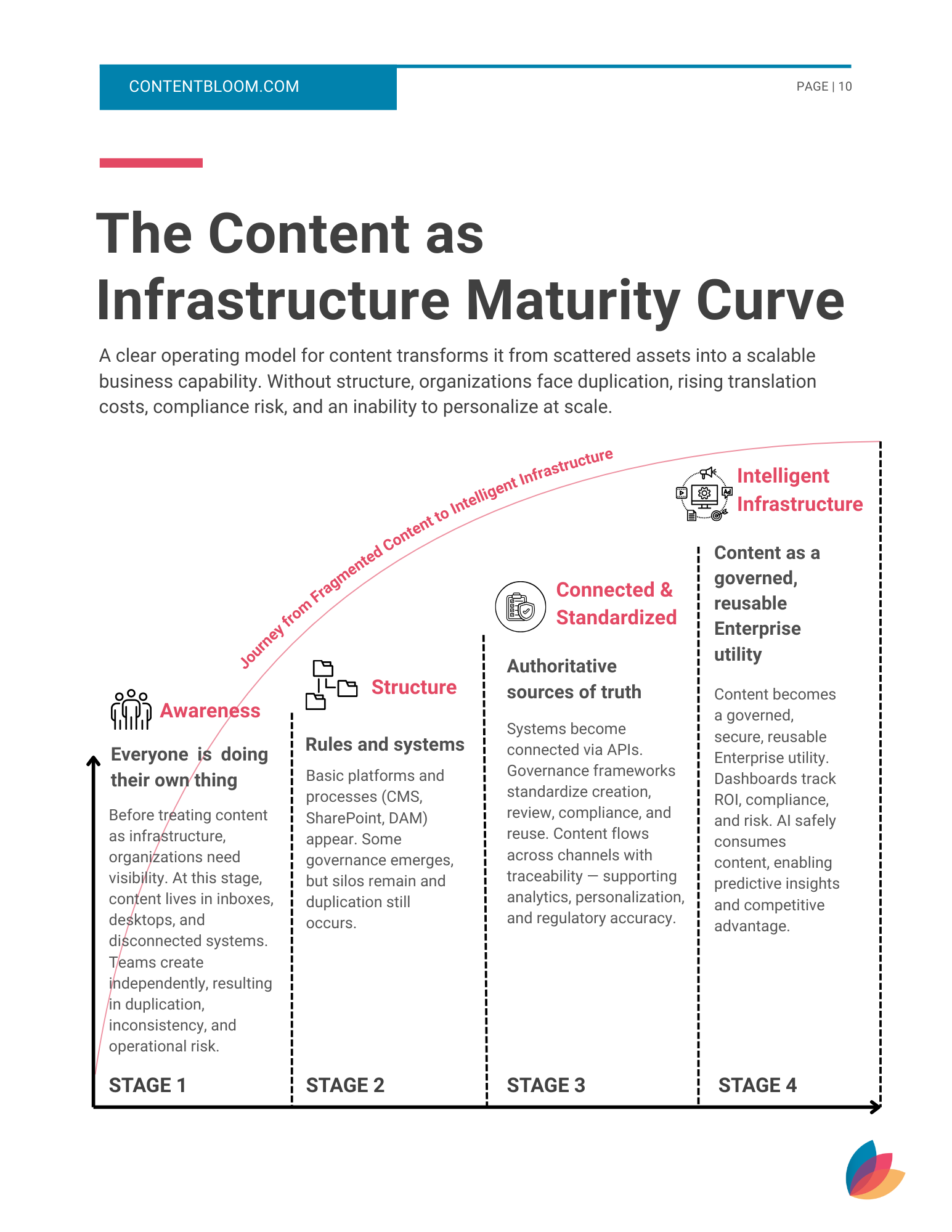
(The Content as Infrastructure Maturity Curve, read more in our Content as Infrastructure white paper )
4. Can you trace content changes end-to-end (Traceability)
Knowledge management and content governance are no longer optional.
Leadership teams should be able to answer:
- Who edited this content?
- When was it changed?
- Who approved it?
- Can we audit it if required?
A robust governance model ensures content is traceable, auditable, and aligned with brand, legal, and operational standards, especially in regulated or compliance-heavy industries.
5. Risk mitigation as a strategic enabler (Governance and Compliance)
Every enterprise carries risk related to brand reputation, regulatory compliance, privacy, and security.
A CMS migration inevitably exposes some of that risk, but it also creates an opportunity to tighten controls.
Key questions include:
- Are roles and permissions clearly defined?
- Are approval workflows consistent and enforceable?
- Are changes logged and auditable?
- Does the CMS support regional compliance requirements such as GDPR, CCPA, and data sovereignty?
Migration should not transfer old risks to a new platform. It should reduce them.
6. Global scale demands global readiness (Translation and Localization)
For organizations operating across regions, content must adapt to local languages, markets, and regulatory environments.
Leadership teams should consider:
- Whether translation workflows are efficient and scalable
- Whether localization is visible and governed
- Whether regional teams can move at speed without compromising brand consistency
Without this, organizations create bottlenecks, inconsistent messaging, and unnecessary risk.
Scale and Sustainability
How the platform supports long-term growth and adoption
7. Will the CMS integrate into your ecosystem (Ease of Integration)
A CMS cannot exist in isolation.
For the C-suite, integration is non-negotiable. The CMS must connect with CRM, ERP, DAM, marketing automation, analytics, translation engines, and other core systems.
Integration is what turns content into a strategic asset rather than a static repository.
8. Will the platform grow with you (Performance and Scalability)
CMS migration is not just about solving today’s problems.
Leadership teams should ask:
- Can the platform scale across regions, brands, and acquisitions?
- Can it handle peak loads from campaigns or unexpected traffic?
- Can capabilities be extended without constant rework?
A CMS should be treated as core digital infrastructure, not a short-term solution.
9. Are assets and documents managed as part of the whole (Asset and Document Management)
Content is more than text. Images, videos, documents, and translations all need to be managed efficiently.
Key considerations include:
- Clean migration of digital assets
- Reuse to reduce duplication
- Effective tagging and classification
- Strong search and optimization across SEO, AEO, and emerging discovery models
Cleaning up assets before migration significantly reduces complexity and risk.
10. People and process matter as much as technology (Adoption)
One of the most overlooked dimensions of CMS migration is the human one.
Even the best platform will underperform if:
- Roles and responsibilities are unclear
- Training and adoption plans are missing
- Teams are not engaged early
CMS migration is a business transformation, not just a technical one. Adoption planning is essential to realizing return on investment.
Final Perspective for Leadership Teams
Moving to a new CMS should never be about swapping software.
Done well, it is a chance to:
- Clean up content operations
- Improve speed to market
- Strengthen governance
- Support global growth
- Enable future innovation
Done poorly, it results in wasted investment, frustrated teams, and a platform that underdelivers.
For leadership teams, the real risk is not choosing the wrong CMS.
The real risk is committing to a platform before agreeing on how content should work across the business.
What to Do Next
If your organization is planning a CMS migration or consolidation, an independent perspective can help clarify:
- Your true business requirements
- The right class of CMS platforms to consider
- Where governance, workflow, and adoption risks sit
Working with Content Bloom helps leadership teams move beyond feature comparisons and towards platform decisions that genuinely support their operating model.
Choosing the right CMS is not an IT decision.
It is a strategic one.
FAQs
1. Is CMS migration an IT project or a business decision?
While IT teams manage implementation, the outcomes of a CMS migration directly affect customer experience, governance, risk, speed to market, and future innovation. Decisions around content structure, workflows, permissions, and integration shape how the organization operates long after launch. That is why CMS migration should be owned by leadership teams and aligned with business strategy, not treated as a routine system upgrade..
2. What risks should leadership teams consider during a CMS migration?
Without clear governance, CMS migrations can introduce audit blind spots, inconsistent approvals, unclear ownership, and regulatory risk. Leadership teams should ensure traceability, enforceable workflows, role-based permissions, and regional compliance (such as GDPR or data sovereignty) are designed into the platform. Migration should reduce risk, not carry existing problems into a new system.
3. How does CMS migration impact long-term growth and AI readiness?
Modern discovery increasingly happens through AI summaries, recommendations, and multi-channel experiences. A CMS that lacks structured content, metadata, and integration capabilities can block future AI initiatives. Leadership teams should evaluate whether a CMS supports scalable content models, analytics, and automation over the next two to five years — not just current publishing needs.