
Author

Morgan Henley Follow on LinkedIn
Morgan, a Senior Technical Consultant at Content Bloom, holds multiple certifications at both a business and developer level for Adobe Experience Manager platforms. She works with the products such as AEM Sites, Assets and Workfront regularly for enterprise clients.
Adobe isn’t just adding features to Workfront in 2026, it’s actually redefining what “work management” actually means.
Based on what was shared at Summit 2026, the vision for Workfront is clear: move beyond project management into a fully AI-driven system for how work is created, executed, and optimized. Ideation, planning, execution, and optimization aren’t separate phases anymore, they’re part of a continuous, AI-supported loop.
It’s a compelling direction, but one that depends entirely on how well the pieces connect.
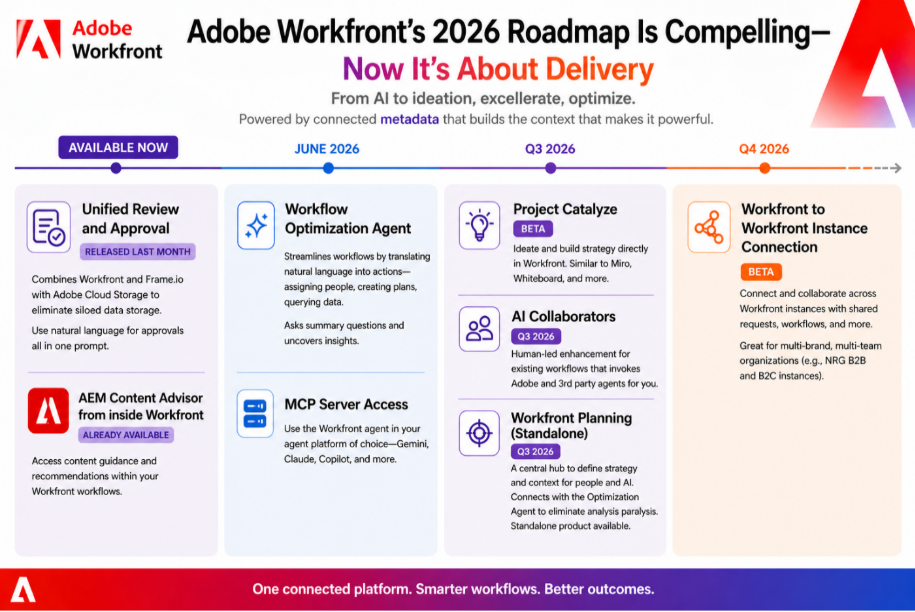
The 2026 roadmap unfolds in a clear progression. Starting with recently released capabilities like Unified Review and Approval and the AEM Content Advisor, Adobe is already tightening integration and reducing fragmentation.
By June 2026, the focus shifts to automation and accessibility through the Workflow Optimization Agent and MCP server access, bringing natural-language and cross-platform AI into everyday workflows. Q3 introduces the biggest leap forward with Project Catalyze, AI Collaborators, and Workfront Planning, expanding into ideation, strategy, and context-driven execution.
To cap off the year, Workfront-to-Workfront instance connections, slated for release in Q4 2026, are a true enterprise-level enhancement. This capability is especially valuable for large organizations operating multiple Workfront instances across different business units. It enables cross-domain collaboration and helps bridge and how organizational silos that have long been a source of friction.
Workfront Wants to Own the Entire Workflow
With Project Catalyze, Workfront is stepping into ideation and strategy, a territory traditionally owned by whiteboarding tools. This isn’t just expansion. It’s a shift in positioning.
💡 Workfront isn’t just managing work anymore, it’s positioning itself as the place where work starts. For our clients already using Workfront as a centralized platform for asset and workflow management, Project Catalyze closes a long-standing gap between ideation and execution. With the ability to ideate directly in Workfront, one of the most common friction points in a mature Workfront environment is resolved. Teams will no longer have to move between their whiteboarding platform and Workfront as ideas evolve into delivery, and for organizations operating in a truly agile capacity, ideation is never really complete. Reducing the constant switching between tools and manual transfer of content not only saves time but also limits the human error that often comes with disconnected workflows.
AI Becomes the Interface
The Workflow Optimization Agent (June 2026) and AI Collaborators (Q3 2026) signal a move toward natural language as the primary interface.
Assigning work, building plans, and querying data become conversational instead of manual, replacing time spent clicking through configurations and workflows with simple prompts. More importantly, these capabilities expand who can meaningfully contribute to workflow optimization within Workfront environments. Operational teams often understand process inefficiencies better than anyone else, but historically needed deeper platform expertise to implement meaningful change. The Workflow Optimization Agent and AI Collaborators lower that barrier, allowing teams to interact with Workfront more like they would with a technical subject matter expert than a traditional enterprise platform.
This isn’t just a conceptual shift. According to Adobe’s official announcement, this new Workflow Optimization Agent is powered by the Adobe Experience Platform Agent Orchestrator. This backend intelligence allows the system to seamlessly convert natural language instructions into structured workspaces, automate template applications, and trigger smart project creations from scratch. In essence, AI shifts from being a passive chatbot to an active, assignable resource on your project schedule.
At the same time, MCP server access means these capabilities won’t be limited to Workfront itself. Users can invoke them from platforms like Gemini, Claude, or Copilot.
That flexibility is powerful, but it also introduces new considerations around governance, security, and operational oversight as more agents become involved in enterprise workflows. Organizations expanding Workfront through MCP server access will need governance models that balance productivity with data access, platform security, and cross-system control. The ability to interact with Workfront through external LLM ecosystems like Gemini, Claude, or Copilot significantly expands accessibility, but it also expands the importance of clearly defined operational boundaries and AI governance practices.
Planning Is the Real Anchor
Workfront Planning, launching as a standalone product in Q3 2026, may be the most important piece of the roadmap. It acts as the central hub for strategy and context, connecting directly with the Optimization Agent to reduce analysis paralysis.
Because without context, AI doesn’t optimize anything, it just moves faster in the wrong direction. Making Workfront Planning available as a standalone product could also open the door for organizations that aren’t ready for a full end-to-end Workfront implementation, but still want stronger strategic planning capabilities.
Finally, Some Needed Consolidation
Unified Review and Approval, which is already released to the general public, brings Workfront and Frame.io together with shared cloud storage, reducing fragmentation. This shared cloud storage will reduce confusion on where to grab the latest version and make it easier for your entire team to view the latest changes.
Add in natural language approvals, and this starts to show what embedded AI actually looks like in practice: not flashy, but deeply integrated into everyday workflows.
Enterprise efficiency takes alignment, not just features.
When Adobe introduces Workfront-to-Workfront instance connections, the biggest challenge won't be the technology, it will be your governance.
The Bigger Picture: Context Is Everything
Across all of this: ideation, acceleration, optimization, the real differentiator is context. Metadata connections are what make the system intelligent. Without them, the entire AI layer falls apart.
Final Take
The 2026 roadmap is cohesive and forward-looking:
- Ideate (Project Catalyze)
- Accelerate (AI Collaborators)
- Optimize (Workflow Optimization Agent)
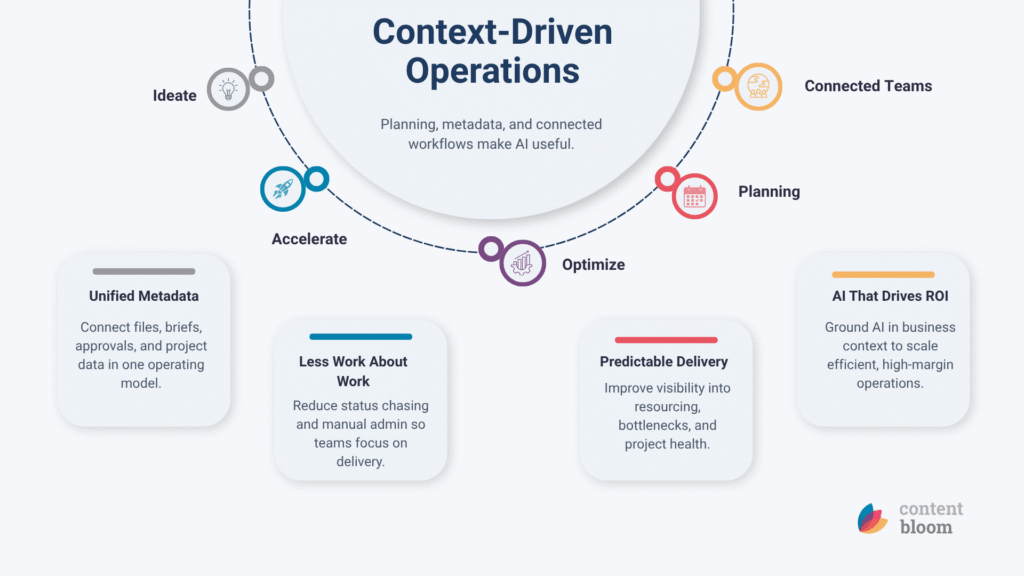
All grounded in Planning and powered by context, but it’s also fragile. This isn’t a set of independent features, it’s an ecosystem. And if the pieces don’t work seamlessly together, the vision doesn’t hold.
For business and commercial leaders, this isn’t just a technical upgrade; it’s a shift in your operational bottom line. When your data, files, and project context live in the same interconnected ecosystem, the commercial outcomes are massive:
- Zero Time Wasted on “Work About Work”: Leaders don’t pay teams to hunt for the latest project brief or figure out which asset version is approved. By anchoring AI in unified metadata, your teams spend less time chasing status updates and more time billable, accelerating your overall time-to-market.
- Predictable, Scalable Delivery: When you connect separate agency partners or internal business units through a single operational language, you eliminate silos. You get real-time visibility into resource bottlenecks and project health, allowing you to safeguard your margins before a project goes off the rails.
- AI That Actually Drives ROI: Disconnected AI just creates faster chaos. But when AI understands your specific business context, it eliminates manual admin work safely. You’re not just saving clicks; you are creating a repeatable, high-margin delivery machine that scales without inflating your headcount.
Execution, not ambition, will decide whether this actually transforms how teams work. Turning this roadmap into real outcomes isn’t just about enabling features, it’s about designing the right workflows, structuring metadata for context, and aligning teams around a new way of working.
That’s where experienced Workfront partners can make a difference by helping organizations move from experimentation to scalable, AI-driven operations.
The roadmap isn’t the destination. It’s the enabler.
The organizations that see the greatest return from Workfront won’t be those that enable the most features. They’ll be the ones that align people, process, platform, performance, and governance around a common operating model.
FAQs
1. What is Adobe Workfront trying to achieve in 2026?
Adobe Workfront is moving beyond project management into a fully AI-driven workflow platform. The goal is to connect ideation, planning, execution, and optimization into one continuous system.
2. What are the biggest AI features coming to Workfront in 2026?
The 2026 roadmap is cohesive and forward-looking:
- Workflow Optimization Agent for automation
- AI Collaborators for conversational work management
- MCP Server Access for integrations with tools like Copilot, Gemini, and Claude
The focus is on making AI part of everyday workflows, not a separate layer.
3. Why is Workfront Planning important to the roadmap?
Workfront Planning is the foundation of the 2026 roadmap because it gives AI the context it needs to make smarter decisions.
Without strong planning and metadata connections, AI can automate work but not necessarily improve it.