Author

Andy Iddon
Andy Iddon has 28 years of digital consulting experience and also co-founded a mental health organization, where he first encountered presenteeism as a workplace challenge. He applies that cross-disciplinary insight to AI content strategy.
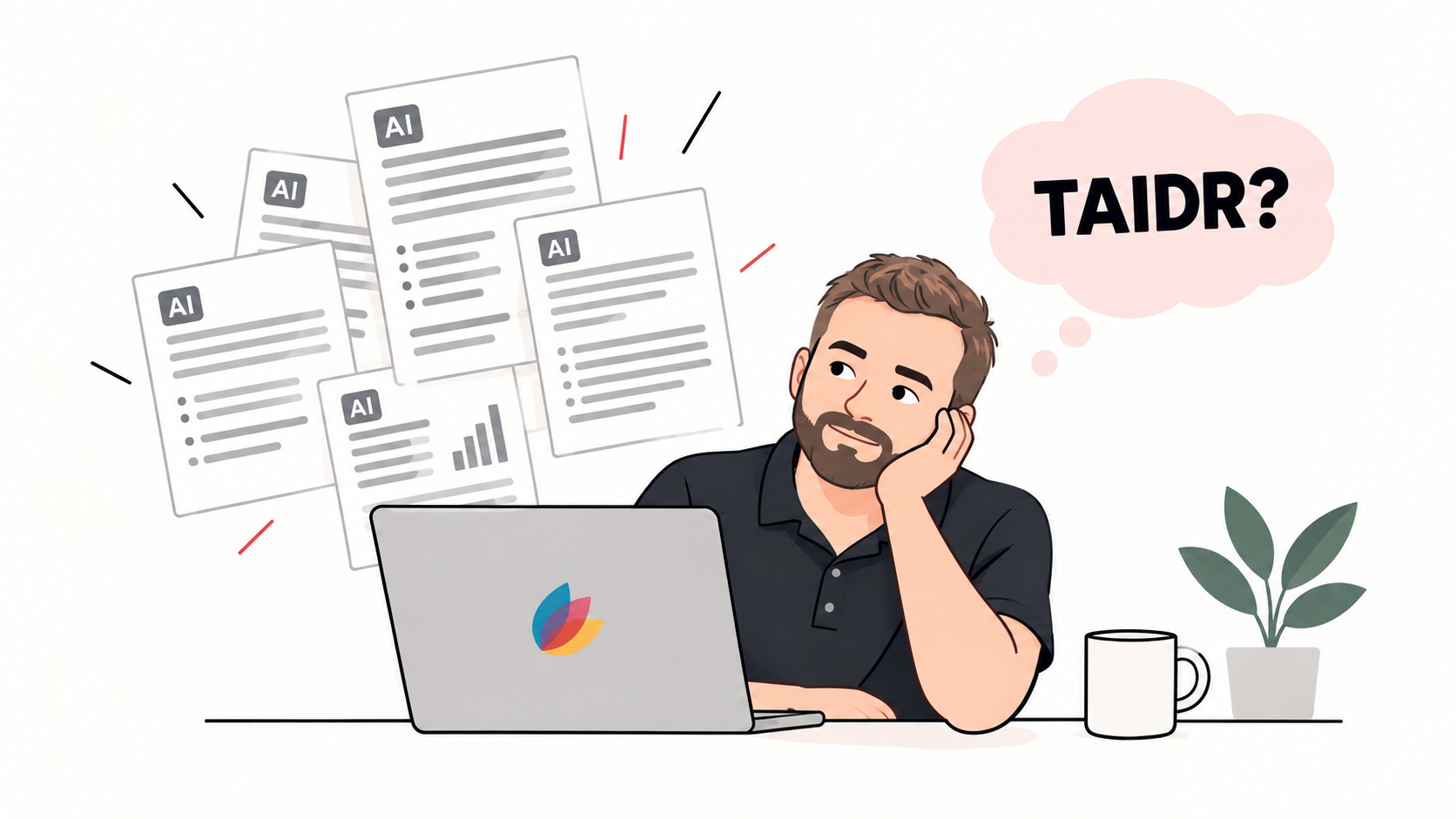
This white paper introduces Digital Presenteeism.
A growing challenge where content is present, accessible, and published, yet may fail to communicate effectively with the systems that are increasingly influencing customer decisions.
For more than two decades, organizations have focused on digital visibility. Search rankings, traffic, user experience, and conversion have become established measures of success. The underlying assumption was simple: if content could be found, it could be used.
However, as AI systems become active participants in discovery, evaluation, comparison, and recommendation, that assumption deserves closer examination.
Over the last few months, we analyzed more than 50 enterprise pages across multiple industries, including product pages, service pages, product family pages, and informational articles. What emerged was a surprisingly consistent pattern. Information that was readily available on a page was not always reflected in the understanding formed by AI systems.
Specifications existed. Evidence existed. Differentiation existed. Yet AI systems sometimes produced incomplete, inconsistent, or uncertain interpretations of the same content.
The issue was not typically visibility. In most cases, the content could be found and extracted successfully. The challenge emerged later, when systems attempted to interpret meaning, evaluate evidence, compare alternatives, and determine whether they had sufficient confidence to recommend what they had found.
Perhaps most interestingly, these observations were not limited to a single AI platform. Across multiple AI systems, similar strengths, weaknesses, and areas of uncertainty appeared repeatedly, particularly around evidence, specification accessibility, commercial readiness, and recommendation confidence.
This raises an important question.
If content can be found but cannot be confidently understood, trusted, compared, or recommended, is visibility alone still enough?
This paper explores that question.
Inside the paper, we examine what Digital Presenteeism is, why visibility and understanding are no longer the same thing, the hidden risks that rarely appear in analytics or CRM systems, the findings from our cross-industry research, and why content infrastructure may become a competitive advantage in an AI-mediated world.
Research Snapshot
- 50 enterprise pages assessed
- 8 industry sectors
- Product pages, service pages, product family pages, and articles
- Multiple AI systems evaluated
The most consistent finding was not that content was invisible. It was that content which appeared clear to its creators was not always interpreted with the same level of confidence by the systems increasingly influencing customer decisions.
The question is no longer whether your content can be found.
The question is whether it is being understood.
FAQs
1. What is digital presenteeism?
Digital presenteeism is a condition where organizational content is visible online but operationally ineffective for AI-driven discovery, retrieval, interpretation, or recommendation. Like an employee who shows up but is not engaged, the content is present but not working.
2. What is Agentic Understanding and how is it measured?
Agentic Understanding (AU) is the degree to which AI systems can reliably extract, interpret, trust, compare, and use digital content during answer generation, recommendation, and advisory workflows.
Content Bloom measures Agentic Understanding using its AI Signals Framework, which evaluates content across five dimensions: Extraction, Interpretation, Confidence, Preference, and Conversion Utility. Together, these signals provide an indication of how effectively AI systems can understand and use a piece of content.
3. What is pre-funnel eligibility?
Pre-funnel eligibility is the stage where AI systems include or exclude organizations from consideration before a customer directly engages with a website or sales process. This filtering step leaves no trace in conventional analytics, no bounce rate, no attribution report, no conversion event. The loss is invisible until it shows up as compressed deal cycles or shorter consideration sets.
4. How do I improve my Agentic Understanding?
The highest-impact improvements are: ensuring all content is fully present in raw HTML without JavaScript dependencies; adding semantic H2 and H3 heading structure and JSON-LD structured data; adding quantified claims, named technologies, and verifiable trust signals; moving evidence from PDFs into HTML-native content; and including commercial specifics such as pricing context, case study outcomes, and clear engagement pathways. Content Bloom provides a free diagnostic for any public URL. Contact a.iddon@contentbloom.com to request one.
5. Why do different AI Systems score the same page differently?
Different AI systems, including GPT-4.5, Gemini Pro, and Claude Sonnet, have different thresholds for confidence, different sensitivities to semantic structure, and different tolerances for vague or unsubstantiated language. In Content Bloom diagnostics, the same page has scored as much as 14 points differently across three engines on the same day. This is why optimizing for one engine is insufficient.
6. What does the free diagnostic include and what does it cost?
The free diagnostic analyzes any single public URL and produces a scored report across five dimensions: Extraction, Interpretation, Confidence, Preference, and Conversion Utility. It identifies specific gaps, shows what AI systems can and cannot say about the organization from the current content, and provides prioritized recommendations. The free diagnostic is available at no cost with no obligation. Contact a.iddon@contentbloom.com to request one. Paid options for multi-page assessments, competitive analysis, and ongoing monitoring are available on request.
7. Why do PDFs create retrieval risk?
PDFs remain significantly less reliable retrieval surfaces for AI systems than HTML-native content. When an AI system crawls a page, it reads the initial HTML response. PDFs linked from that page may not be retrieved in the first pass, and even when they are, the content is weakly connected to the surrounding page context. Case studies, technical specifications, and performance data stored only in PDFs are at high retrieval risk when AI systems construct advisory or recommendation responses.