
Author

Nicholas Wetmore Follow on LinkedIn
Nicholas Wetmore, a Senior Technical Manager at Content Bloom, has more than 12 years of experience with the company, progressing through senior technical consulting and management roles. He works closely with enterprise clients on complex technical solutions and delivery.
We all know TL;DR: Too Long; Didn’t Read.
I think we need a new one:
TAIDR: Too AI; Didn’t Read.
An associate of mine described how he decides something is worth reading. He asks himself:
“Did the writer read it themselves?”
That stuck with me.
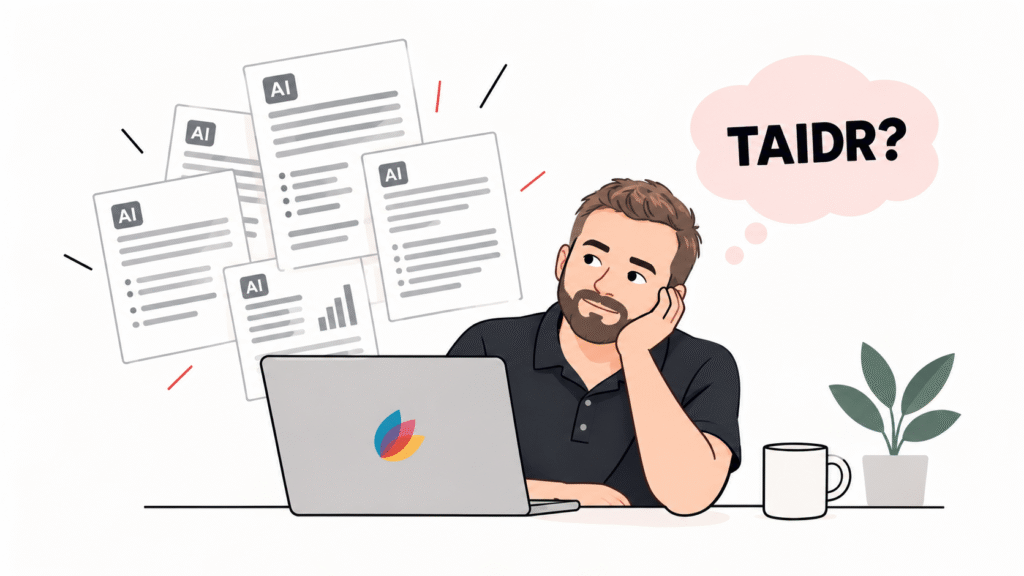
Image generated by ChatGPT 5.6 Sol.
AI has made producing polished content almost frictionless. Give it a prompt and seconds later you have 1,500 words, neatly structured, grammatically correct, with headings, bullet points and a tidy conclusion.
And much of it is perfectly good information.
That’s most of the problem.
When I write something to a colleague I know well, I know what they already know. I don’t need to explain the background, define familiar concepts or build the argument from first principles. I can give them the four or five sentences that are actually new and useful.
AI rarely has that context.
So it fills in the gaps. It explains. It provides background. It structures everything into neat sections of paragraphs and bullet points. When we review, we see a wealth of accurate information and think: “Perfect! So many valuable facts in this well-structured article!”
So we send it.
The reader has a different experience. They read the first few paragraphs and think, I know this. I know this too. Where is the part I actually need?
Eventually, finding the signal becomes more work than the information is worth.
TAIDR.
The emerging responsibility of the AI-assisted writer is to know your reader well enough to remove what they already know.
AI can help research, challenge, edit and articulate an idea. The human still decides what deserves the reader’s attention, then ensures the reader can efficiently appreciate the intended point.
There was a “flaw” with people writing their own messaging: it took time to type. That same flaw encouraged people to write as little as possible. Naturally, folks summarized their point and cut out the unnecessary pretext. With AI, we’ve traded time-to-write for time-to-read unless the author takes care to protect the reader’s moment.
Before I send something, I’m increasingly asking myself two questions:
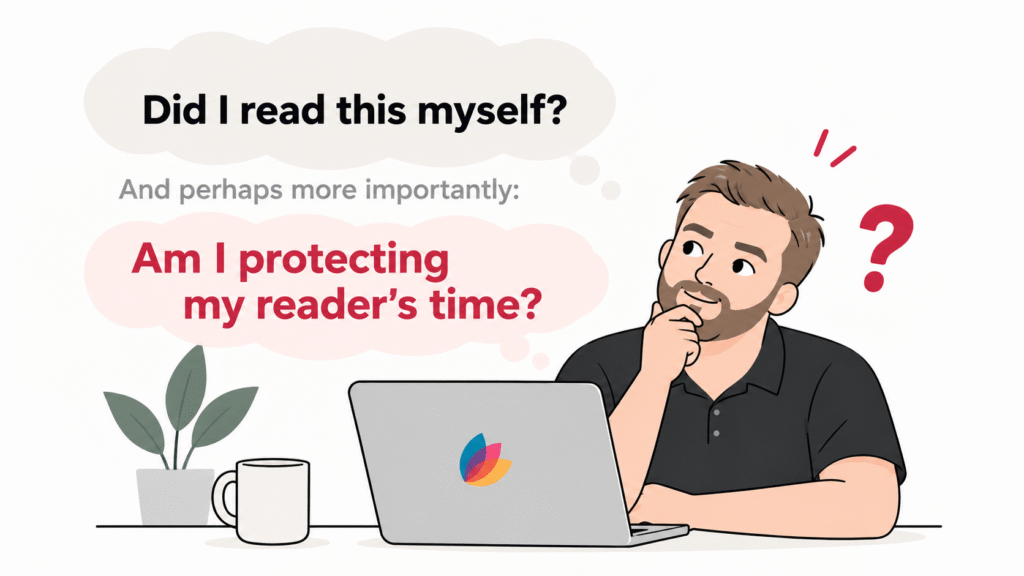
Image generated by ChatGPT 5.6 Sol.